Photo source: https://www.collierschools.com/steam
Background of STEM
When I was researching for this post, I was surprised by just how new the concept of STEM is. I had the misconception that STEM was a new term for an ideology that had been recognized for a long time. In part this is true. According to the Dottie Rose Foundation, the acronym as we know it today was coined in 2001 by Judith Ramaley, and work towards STEM as we know it began in 1862 with the opening of universities for agricultural science, and the reflection of STEM jobs in the workforce. They add that WW2 furthered advancements in STEM due to the military and academic advancement, which then led to many advancements in technology ranging from the race to space and to the cell phone. While these were advancements towards welcoming in STEM, the 1990s really highlighted the idea of STEM as an educational setting and this is where the acronym SMET was formed. Later, in 2001 it was reimagined as STEM.
STEM is a term to encompass science, technology, engineering, and math. Among the many reasons why educators, parents, and students love STEM, innovation and critical thinking are widely acknowledged. These skills can then be applied towards solving issues in any field.
STEM vs. STEAM
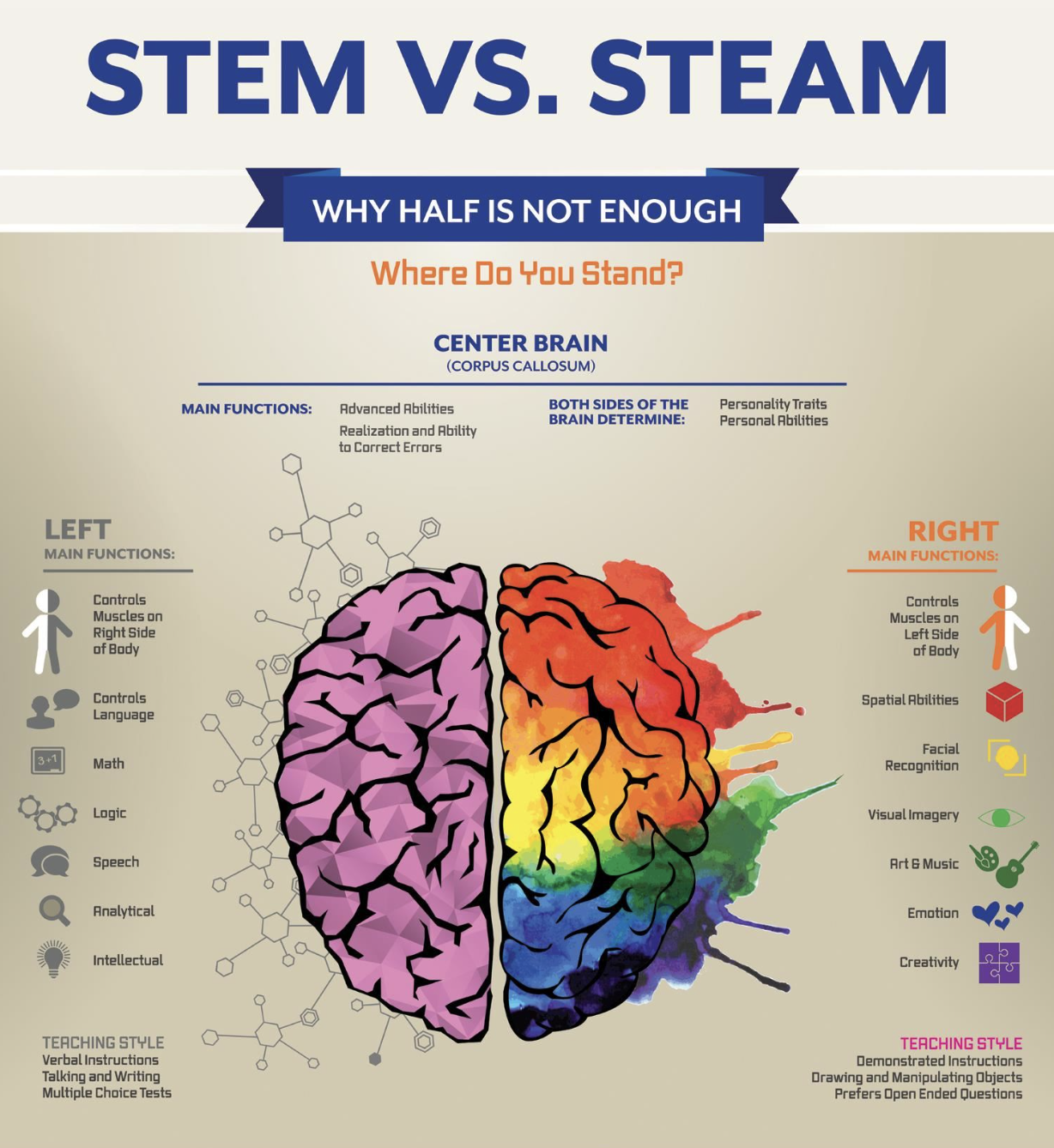
While STEM education has many benefits, University of San Diego argues that STEAM is even more beneficial. STEAM stands for the same four areas plus art. The University of Central Florida includes “the humanities, language arts, dance, drama, music, visual arts, design, new media and more” all as fitting under the arts category of STEAM. UCF notes that a 2018 LinkedIn report recorded 57 percent of senior leaders as valuing soft skills over hard skills. This statistic is important in the argument for STEAM as science, technology, engineering, and math generally require a large focus on hard skills and technique, whereas the arts require an emphasis on creativity and communication. These soft skills make the arts incredibly beneficial in the workforce and can help strengthen personal characteristics beyond the workplace. UCF further cites that a 2019 LinkedIn evaluation found that “creativity, persuasion and collaboration are the top three skills companies seek in prospective employees.”
University of San Diego furthers the argument for STEAM. Citing former President John Maeda of RISD (Rhode Island School of Design), USD adds that “design thinking and creativity are essential ingredients for innovation” particularly because of the reinforcement they add to traditional STEM applications: “practices such as modeling, developing explanations and engaging in critique and evaluation (argumentation), have too often been underemphasized in the context of math and science education.”
Returning back to one of the benefits of STEM, Yeti Academy wrote that “STEM Teaches Critical Thinking and Innovation.” So often, STEM is associated with the words “innovation” and “critical thinking,” but the arts strengthen these characteristics in a way that science, technology, engineering, and math can’t. The arts provide deeper thought, connection, meaning, and reflection into the technical actions that STEM promotes. The STEM we reference so often really is what STEAM is, but without the acknowledgement of art’s impacts.
 Teach Through Art