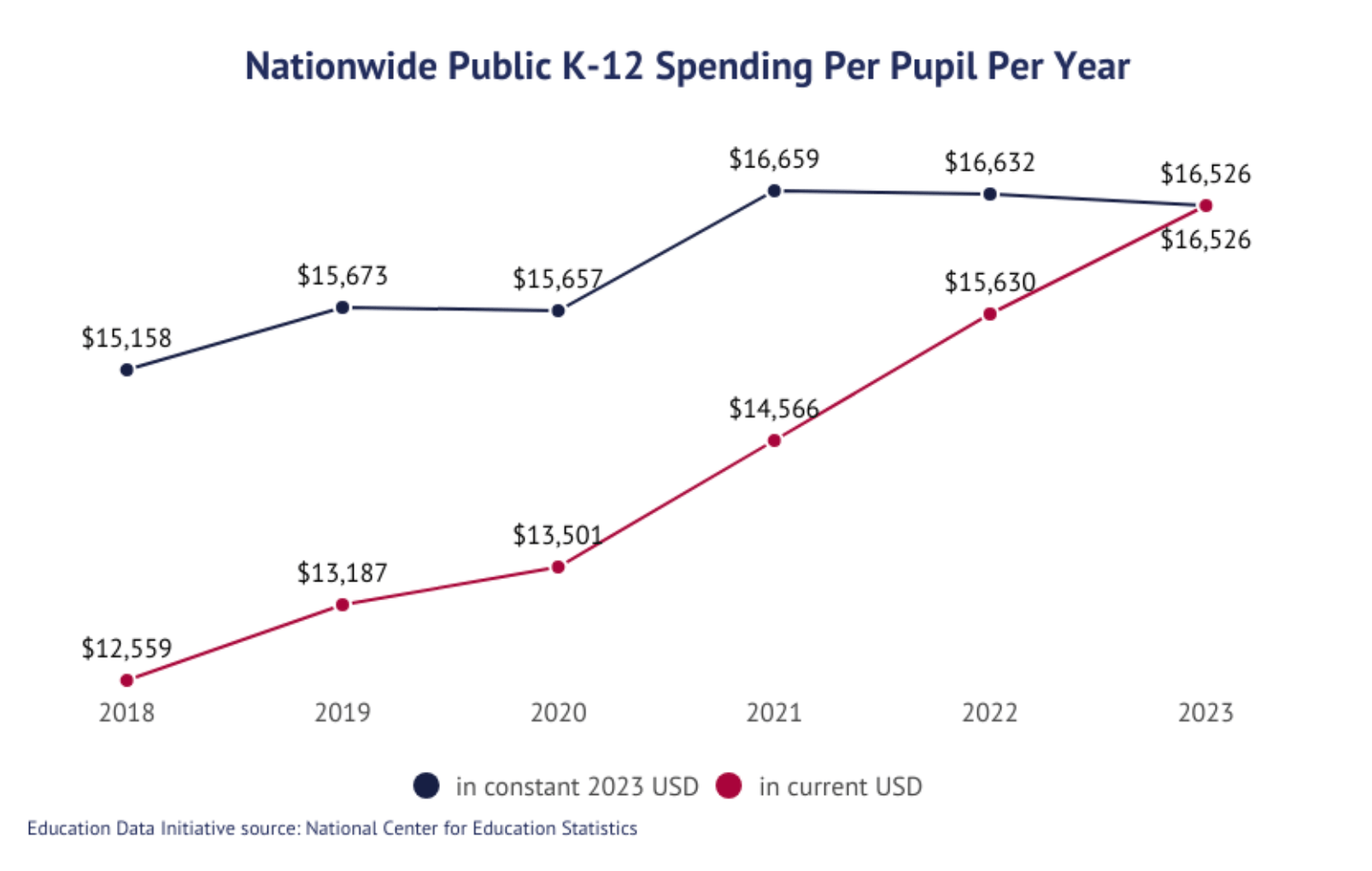
Graph of 2018 to 2023 national funding per student K-12 (photo from https://educationdata.org/public-education-spending-statistics)
Introduction:
Covid was supposed to be the rough patch. No one knew when Covid would be over, but post-Covid was supposed to signal recovery. Economic stability and full classrooms were supposed to be normal.
But the impacts of Covid remain in 2026. In fact, we are still entering new phases of Covid’s long-term implications.
Education relief funds were provided to schools during Covid, but now schools are facing realities where Covid’s relief won’t be present in the years to come. Reduced funding in education means reduced funding for the arts.
The Importance of Funding in Education:
There’s often a debate about whether money can bring happiness. While there are arguments regarding both sides, the importance of educational funding isn’t quite as controversial.
Funding for education plays a crucial part in shaping educational experiences for students. Funding also provides resources academically and socially that oftentimes can help bridge gaps for different underprivileged groups. Benefits stretch beyond students. With more funding, qualified educators are more incentivized to find work, working conditions are improved, and teachers can have the resources to continue improving their teaching styles.
Even further, education brings incredible benefits to the communities we live in. Education is key in building the minds of the future, and education that is equitable makes sure that people from all different backgrounds get the opportunities to display their backgrounds and perspectives.
To put it simply, funding is crucial to education and the opportunities it propels students for the future.
How does funding impact the arts?
While art doesn’t necessarily need funding in order to work, funding plays a crucial part in maintaining art education in schools in similar ways as it does basic education. Funding provides resources such as paint, clay, and cameras. Additionally, one of the biggest ways funding benefits arts education is through employing teachers, allowing for direction, supervision, and overall implementation of arts within schools’ offerings. This increases direct offering of art in a school’s curriculum or extra-curriculars.
While we agree that education funding is critical, funding for arts has had noticeable turbulence as there is not a general consensus on the importance of the arts.
For instance, California’s Prop 13 indirectly contributed to less financial attention towards the arts as property taxes were cut and funding for California went from local community controlled to state controlled. This shift in control led to not only less funding in general, but also more standardized financial choices as opposed to more individualized community choices. Prop 13 was created in 1978 and still remains intact with slight adjustments over time. The remaining structural framework of Prop 13 determines how much flexibility local districts have when funding tightens.
In a general sense, California’s Prop 13 is not directly detrimental to funding for arts education, but there are indirect effects that can greatly contribute to reduced funding for the arts. On the flip side, California has also had more direct acts such as Prop 28 that have positively contributed to funding for the arts. Prop 28, also known as the Arts and Music in Schools (AMS) Act, guarantees funding annually for art programs across the state.
Educational funding trends:
Over the past decade, funding for overall education has risen. Specifically from 2018 to 2023, K-12 education funding generally rose steadily from $12K to $16K. While growth took a slight dip around 2020, these funds continued rising in the following years up to 2023. However, this growth can’t be taken for granted. Because temporary relief funds were provided to schools to ensure as much stability during Covid as possible, funds from 2024 to 2026 were predicted to fall 11.38% in K-12 and postsecondary education. This information could mean that the rising trends we see right now are not accurate representations of what education funding in the future will look like.
Why this matters:
So often we hear that the arts are the first to go after budget cuts. In fact, I was watching my school’s musical this weekend, and somehow the line was in Pippin: “When the king makes budget cuts, the arts are the first to go.”
Drops from Covid are not the worst of our problems. According to EducationWeek, recent federal funding freezes regarding “illegal DEI” and “gender ideology” in schools have reportedly resulted in withheld funding. As a result, schools are having to cut the resources they provide to students, including mental health and college counselors.
Cut access to general resources almost certainly guarantees that arts’ supplies are withheld. With additional cutting of mental health counselors, built-in spaces that students previously could rely on for expressing their feelings are removed. Less college counseling services for families, particularly first-generation college hopefuls, have strong potential to limit the post-high school opportunities students find themselves. Without the skills and ways of thinking art provides, many of these students are left without the opportunity to learn the soft skills that are built into college curriculums and experiences. Pushing students directly into the workforce with the underdevelopment of soft skills and the lack of a credible institution’s name can result in unfound potential through harsher career placement.
General education budget cuts are bad, but the selection of certain groups to face budget cuts is even worse. For me, the ceramics studio is a place I go to when I need time to process my thoughts or want to take some time to simply see where creativity takes me. A life without the precious time to work with clay or without the experiences creatively and socially with my friends in each of my school’s art classes would not just mean much more limited creativity in my life, but reduced relationships with the people I’ve come to call my closest friends through art.
When everything is inequitable, art should be accessible. Art is not a luxury; it’s a stabilizer. If budget cuts are made, art should be the first to stay.
Sources:
Why Are Schools Getting Rid Of The Arts?
Proposition 13: 40 Years Later
Prop 28: What We Know (So Far) – UPDATED JUNE 2025
California spent nearly $1 billion to boost arts education. Are schools misspending it?.
U.S. Public Education Spending Statistics.
In Trump’s First Year, At Least $12 Billion in School Funding Disruptions
Resources to learn more!
How Are Museums Supported Financially in the U.S.? (learn how government funding impacts museums!)
 Teach Through Art