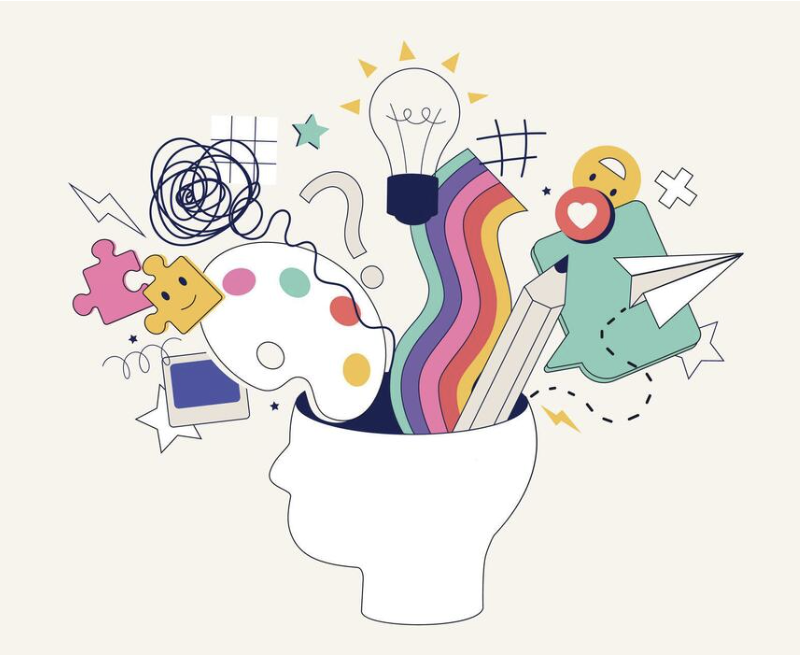
In my last blog post, I wrote briefly about my project Creativity Spark: a project emphasizing unscripted creativity, rather than rigid instruction. In order to achieve this goal, each art box is designed to teach younger students foundational creation skills before giving them freedom to create. A single sentence describing an entire project of intent can make each word sound vague or unrealistic, so in this blog post I hope to break down what I call “unscripted creativity” and why it is important.
Learning to pivot and build on:
You’ve likely heard the phrase “yes, and…,” and if you haven’t, you’ve likely encountered it before. Whether in the context of improv or in some sort of negotiation, “yes, and…” is the idea that you should never shut down someone’s idea, rather you should simply tweak it. In improv, it makes sense; you need to embrace what is coming your way to keep the show going. In the context of negotiation, “yes, and…” allows you to validate and align yourself with whoever you are speaking with and shift their view to seem more like yours.
The idea of “yes, and…” can apply to almost any scenario, and for good reason. It emphasizes accepting what is given to you, then making it your own. This correlates strongly with art. You can plan your project and think of every possible detail you want in your piece, but mistakes are bound to happen. Suddenly, your vision can seem ruined. Some artists may successfully paint over their mistake, but sometimes we can get so caught up on fixing a mistake that it takes more effort than it’s worth.
A tiny dot on a giant wall piece you accidentally smeared? What are the chances someone notices? Or as my childhood book Beautiful Oops! so perfectly illustrates, sometimes a drop of paint can turn into a new character in a story.
Mistakes are bound to happen, whether in art or general life, and allowing kids to navigate setbacks within the confines of a crafting project or 8.5” x 11” piece of paper allows them to practice pivoting before they enter the real world.
Practicing disappointment:
Now, imagine yourself as a child and a time you had a vision for something. A time you wanted something so badly, but once you got it, it didn’t work out like you imagined. For me, that would be the time I wanted to be a librarian-artist for Halloween. I thought it would be the solution to all my problems. I could have hidden pockets inside of a fake book I carried and nobody could ever steal my candy. And the artist part would add the cool effect because I could have glow-in-the-dark glue guide me and I wouldn’t even have to hold a light stick. As you can imagine, this “perfect” idea was not so perfect in reality. The book/box was hard to carry for an extended period of time and the glow-in-the-dark glue was never going to be bright enough to replace a light stick. At that moment, my disappointment was immense. I had truly believed that I had solved all my biggest problems, and I had even convinced my mom that this was the perfect costume just for it to fail!
As a kid, moments like these teach us to embrace a magnitude of emotions that are very hard to replicate later in life. Young children have the opportunity to dream without limits in a way that adults are much more reserved to do because the stakes are higher. If someone’s first experience of disappointment in a seemingly foolproof plan is in adulthood or even later as an older child, it might not seem so obvious to move on and find a course of action.
Unscripted art provides the opportunity to learn how to pivot past mistakes in the face of heightened disappointment. You’re more likely to care if it’s a project you created and envisioned in your head. And if your biggest vision is creating a carbon copy of a DIY kit, you create a roadblock for yourself. You learn that each step must be perfect rather than an opportunity to branch out.
So what is unscripted creativity?
I started this blog post expecting to write about exploring individuality and the statistics behind unscripted activities in an increasingly judgemental and planned world, but in the process of writing, I found myself digging deeper into the reasons I truly had begun Creativity Spark in the first place. I wrote to explore what I believed, just as I hope kids learn to create to understand who they are and their tastes.
I’ve spent a lot of time building up to what unscripted creativity is, and I think you likely see why I believe it’s important and have a sense of what it is, but let me answer that question straightforwardly. Unscripted creativity is the freedom for a kid to look at a box of materials and create an image in their mind of what they want to see in the world. It is the gift of learning to embrace disappointment and welcome pivots, and at the end of the day, it’s the mindset that even though the product you’ve created now looks nothing like the image you imagined at the beginning, it still deserves a giant smile.
Sources:
https://art21.org/read/yes-and-how-artists-are-using-improvisation-and-spontaneity-in-their-work
https://artdependence.com/articles/the-art-of-surprise-embracing-spontaneity-in-creativity
Resources to learn more!
https://www.apa.org/topics/children/kids-unstructured-play-benefits
https://helpmegrowmn.org/HMG/HelpfulRes/Articles/WhyUnstructure/index.html
https://pmc.ncbi.nlm.nih.gov/articles/PMC7012801 (not super related, but found it really interesting to see how powerful the arts truly can be in mental health practices)

