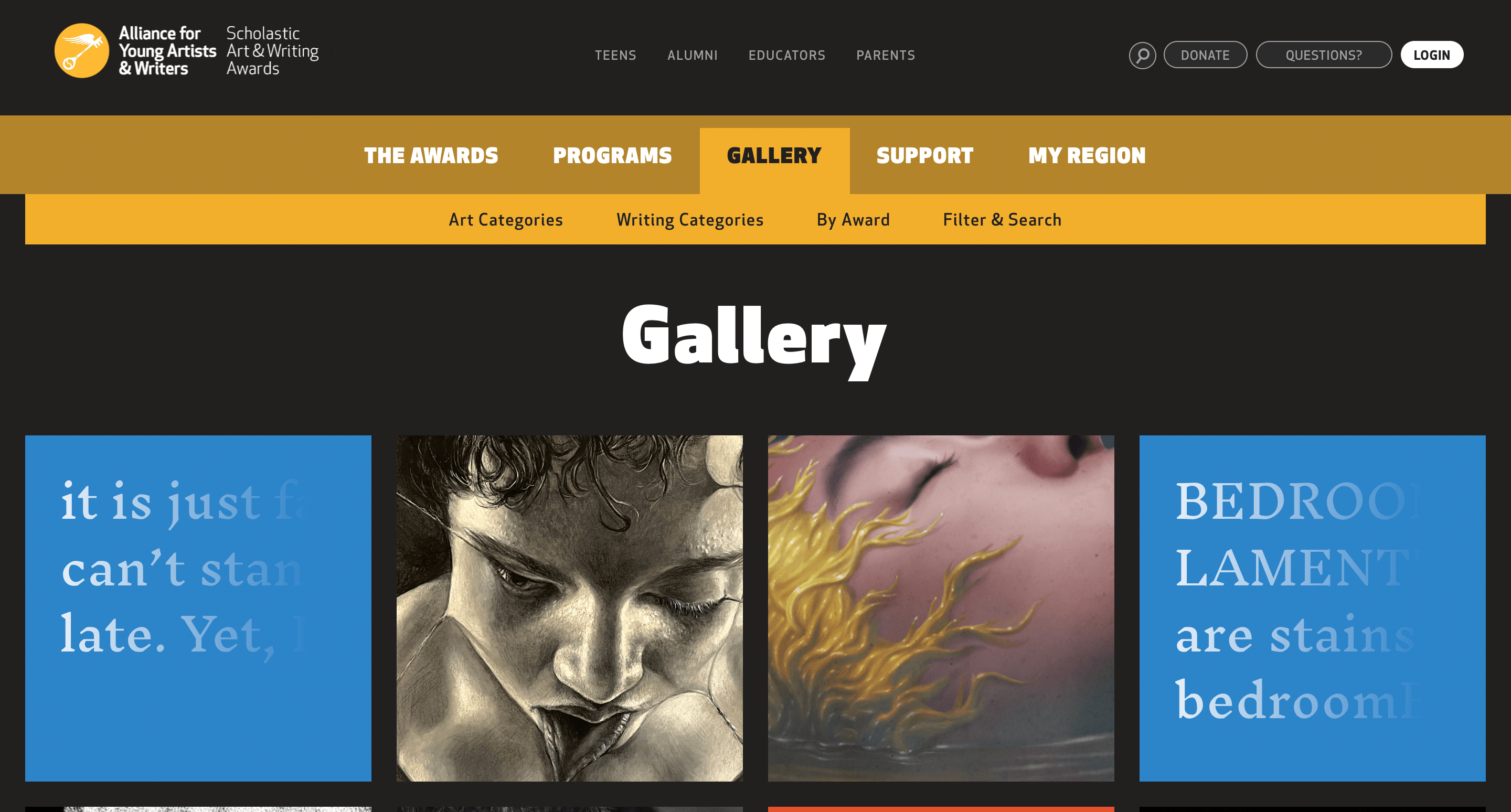
Screenshot of Scholastic 2026 gallery homepage
As I enter my last year of high school, I’ve recently spent a lot of time reflecting on my growth and accomplishments from my time as a freshman to my time entering senior year. One of the most unexpected things I found was the relationship between my efforts to push my art out to a larger audience, and my growth as an individual.
So far, I’ve entered my art in three different competitions: Scholastic Art & Writing Awards, American Museum of Ceramic Art Annual High School Ceramics Exhibition (AMOCA), and the National K-12 Ceramic Exhibition (NCECA K-12). Each has provided unique exposure to a professional world.
Scholastic Art & Writing Awards, the biggest of the three in terms of applicants, is considered one of the most prestigious arts awards in the nation. With awards recognizing teens both regionally and nationally, Scholastic provides an amazing gateway into being recognized officially for artistic work. For me personally, this was my first time seeing my work recognized outside of my school and it was a major sign of encouragement for me to apply to other competitions.
The American Museum of Ceramic Art (AMOCA) provided me with a similar opportunity, but on a more local scale. While the AMOCA high school exhibition is open to students across the nation, it’s lesser known due to its focus specifically in ceramics. As a result, a majority of the submissions are from California since the museum is located in Pomona, California.
Similarly, the National K-12 Ceramic Exhibition attracts many applicants from areas around the host city. One thing this specific application process taught me was how to package fragile pieces, and I had to fill out a more lengthy scholarship application causing me to really reflect on why I do ceramics and what draws me in.
Overall, the skills I gained from submitting my work to these various institutions led me to understand how to present my work, advertise my work to others, and gave me recognition I needed to understand my strengths. Being from California, I originally viewed the competitive nature of California, particularly southern California, as more of a negative. However, after realizing how many people from California are recognized I began to contemplate whether I would even be participating in these competitions had I not lived in California. This made me wonder, is there a relationship between where recognized artists are from and access to the arts?
The data
While it’s difficult to pinpoint the exact number of artists recognized in each state in comparison with one another, there are certain trends we can look at.
Since ceramics is what I’m most familiar with, I’m going to be looking at the overall trend at AMOCA first. As I mentioned earlier, California dominates this list with 56 out of 138 artists being from the state in the 2026 competition. Outside of that, Washington, Oregon, Maryland, South Carolina, Illinois, Florida, North Carolina, Arizona, and New York had relatively similarly high levels of participation with around six people per state gaining recognition. One major trend I found was that generally a state had high participation from a single school or two. This leads me to believe that one of the biggest inhibitors for these competitions is the level of familiarity and the resources a school can provide.
When I compared AMOCA to Scholastic, the data seemed to support the idea that levels of familiarity played a role in participation. While I don’t have access to the exact numbers, students from every state in the United States participated in the awards. This statistic isn’t absurd given that 110,000 students entered 335,000 submissions with 50,000 students winning 92,000 regional awards.
What the numbers indicate
These Scholastic numbers indicate that there is no shortage of youth art submissions across the nation. However, when we zoom in, questions about access still remain. For instance, application fees can be a barrier that can prevent many from participating in competitions. Well-known, successful organizations like Scholastic have the resources from sponsors who know that an investment into supporting a competition like Scholastic truly will put their name out. However, lesser known organizations, or organizations that don’t consider this aspect are put at risk of excluding those with lower income backgrounds.
Additionally, we saw earlier that many of the AMOCA recipients by state were made up of recipients from one school. This trend indicates the importance of the resources a school offers. Ceramics, for instance, is an extremely expensive art form. To build foundational skills, much less create selected pieces, you have to be in an environment that is willing to invest in the materials. This is why art in schools is so important. An individual or family can try to invest in the wheels, clay, materials, and glazes of an art form like ceramics, but it’s much more expensive for an individual to do this. Should a school on the other hand invest, they are able to transfer their materials through a cycle of students to reach many more students for the same price.
Another really important factor I want to make sure to highlight is teachers. For me, I only ever first submitted to these art competitions because of my teacher. She made these opportunities for me possible and gave me the skillset to experiment and stretch my limits. Beyond competitions, a passionate teacher could find ways to provide students a way to use mediums financially restricted from them. They could find other much more cost effective methods such as using air-dry clay or finding introductory ways to teach drawing and painting to reach youth looking for creative outlets.
Before I wrap up, I really want to take a moment to point out a cause of surprise for me. I was looking through the amount of funding the National Endowment for the Arts distributed to each state over the past 5 years and decided to divide that by the number of students in the state. While obviously the money doesn’t go entirely to education and has a huge part in job creation, I thought this would be a good measure to indicate the population to funding ratio. California, being the state I’m from, was the first state I looked at. I found that if that entire supply of funding was split across all the students in California, each student would have around 12 dollars. I then did this for South Dakota, a state that appeared less prevalent in the competitions I reviewed. They would have around 99 dollars per student in this imaginary scenario.
In context with the rest of the reflections I’ve had in this post, I think this only cements how much raw statistics can’t represent the level of access and equality for students in the arts. A state like California, for instance, can seem like a major producer of talent, but at the same time it has extremely affluent neighborhoods that may get more funding than others creating a disproportion not highlighted in raw data.
Ultimately, yes, recognized art takes a level of talent. However, this talent is greatly shaped by environmental factors such as raw resources and teacher support. With these awards having the capability to open doors, not just artistically but also academically and personally, providing greater equality in resources can help us better open doors to communities generally less privileged with opportunities.
Sources:
National Endowment for the Arts: State Profiles
Enrollment in public elementary and secondary schools, by region, state, and jurisdiction: Selected years, fall 1990 through fall 2023
2026 Annual High School Ceramics Exhibition (AMOCA)
The Scholastic Art & Writing Awards Announce 2026 Class of National Teen Medalists
Resources to learn more!
The Top 100 Most Arts-Vibrant Communities of 2025
SMU DataArts Releases Second Annual Ranking of Most Arts-Vibrant States in the U.S.
Arts and Cultural Production Satellite Account, U.S. and States, 2023
Creative Economy State Profiles
50 States of Arts Participation: 2022 (find out how art compares to other activities)

